
A company agent in every team chat, working as the person who asks.
One agent per workspace that knows your company’s records and rules. It works in Slack, Teams, WhatsApp, Telegram and email, acts as the person talking to it with that person’s permissions, asks before it changes anything that matters, and runs routine work on a schedule through workflows.
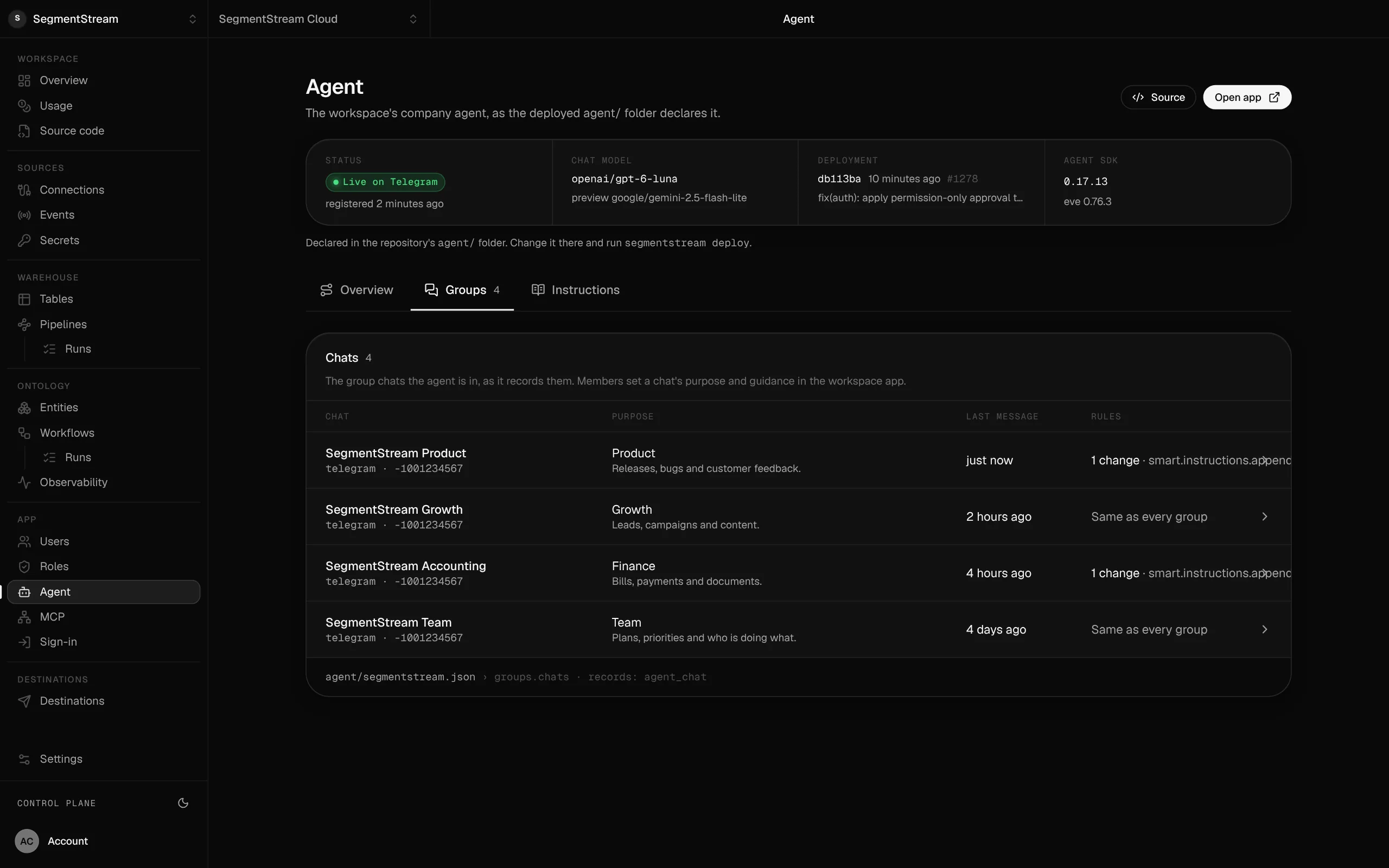
The company agent as its agent/ folder declares it: the team chats it is in, what each one is for, and the deployment it runs.
Ask in a chat. Get an answer with your own permissions.
It knows who is asking
Ada connects once. Every answer after that is read with her roles, and every change is recorded as hers.
It asks before it acts
Moving a deal or adding a task runs the same actions the app runs, with the same rules inside them. Before a change that matters, it shows the change and waits for her to confirm.
It stops where the role stops
Revenue needs the accountant role, which Ada does not hold, so the agent says so instead of answering. No prompt can talk it past a permission.
In every team chat and inbox
The company agent works in the channels your team already uses: Slack, Microsoft Teams, WhatsApp, Telegram and email. Every workspace agent also has its own email inbox, so customers and suppliers can write to it directly.
Acts as the person asking
Each person connects once. From then on the agent acts as that member, with the roles they hold at that moment, and the history of every change names them.
Asks before it acts
Before it changes anything that matters, the agent shows what it will do and waits: confirm, edit or cancel. When something is unclear, it asks.
Reads what your team sends
It reads documents, scans, spreadsheets and voice messages, works with files in a private sandbox, and attaches what it produces to the right record.
Works on its own, on a schedule
Workflows start the agent on a schedule or when something happens: check yesterday’s bank transactions, find the leads nobody followed up, sort the inbox. It reports back in the team’s chat.
Fits into group conversations
In a group, it answers when someone addresses it or asks for something it does, and keeps the rest as context. It can post updates to other chats and remembers past conversations.
A model per role
Pick a model per role, for example a stronger one for finance. Model calls go through a gateway with the deployment’s own identity: no key to configure.
Stops when access stops
Deactivate a member, or let them disconnect in the app, and the agent stops acting for them at once.
In code
<!-- agent/agent/instructions.md -->You are Acme's operations agent.- Answer from the company's records, and say which record you used.- Before you change a deal, an invoice or a contract, show the change and wait for the person to confirm it.- If a document is attached, read it and file it on the right record.// agent/segmentstream.json{ "sandbox": true, "confirmations": { "mode": "deferred" }, "groups": { "mode": "smart" }}Use it, build on it, or have it built
Use it
Add the agent to your team’s chat, connect once, and ask.
Build it with your agent
Your coding agent writes the agent’s instructions and channels in agent/ and deploys; the agent starts answering.
Have our engineers build it
Our engineers set up the agent, its channels and its first workflows with you during a pilot.
Replaces Chatbots with a shared service account, One agent per SaaS tool and Bot tokens in code.
Works with
Solutions built with it
Read more
- 8 October 2026Agent sprawl: how to run a company on one AI agent instead of 3,000Companies are building AI agents by the thousand, each with its own instructions, its own keys and its own copy of the rules. Vercel went the other way and moved hundreds of internal agents behind one. Here is how a company runs on a single agent, and what has to sit behind it.
- 8 October 2026MCP gateway vs raw MCP servers: how to run a company through any agentEvery tool your company uses now has an MCP server, and the usual way to give an agent access is to plug them all in. It demos well and breaks on permissions, rules, context and the next agent you try. An MCP gateway over your company's ontology gives every agent one door, with your own actions, roles and history behind it.
- 7 October 2026Read this before you cancel HubSpot or SalesforceCompanies are cancelling CRM contracts and having AI agents write their own. Writing the CRM is now the easy part. What decides whether it survives is the layer underneath it: objects, permissions, actions, history and safe access for agents. That layer is called an ontology.
- 3 October 2026SaaS becomes company contextAgents are now how people ask questions and get work done. The CRM, the BI tool and the warehouse stop being separate products and become one thing a company owns: its context. Here is what that is made of, and why we're building it.
Start a pilot.
Want company agent set up for you? Our forward-deployed engineers build it with you in your workspace, as code you own.
- One solution, on your data, in your own workspace
- First version live in two weeks
- Parity proven before anything is switched off
- Fixed scope and price, credited to your contract if you continue
Not ready for a pilot? Send the form anyway with your question. An engineer will reply, not a sales rep.
How the pilot worksBuild your company’s own software. Let agents run it.
$ segmentstream workspace create acme --region eu --subdomain acme
▸ Created workspace acme · database, warehouse and a private git repository
$ segmentstream workspace WORKSPACE-ID clone acme && cd acme
▸ your coding agent builds what your team asked for and runs the checks
$ git add -A && git commit -m "First version"
$ segmentstream deploy
▸ app, company agent, API and MCP tools live for your invited members
Our engineers build the first version on your data in two weeks, at a fixed price.
Or build it yourself with your coding agent:
curl -fsSL https://segmentstream.com/install.sh | sh