
Lead scoring, cost data and attribution, as code in your workspace.
Build your own marketing measurement, from the first visit to a qualified lead or sale. Grade demo requests against your own standards, bring ad costs together across channels and see which campaigns get credit. Your team owns the code behind the reports.
Build your own marketing measurement
You decide what counts as a conversion and how much credit each campaign gets. SegmentStream runs the building blocks that take you from a visit on your site to a report your team can use.
Collect website events →
Your tracker records page views as people browse. The collector accepts events as they arrive, individually or in batches, and streams them to your warehouse.
Turn visits and ad spend into reports →
Use scheduled data pipelines to group page views into visits, match visits to campaigns and calculate what each lead cost. You can rerun earlier dates when your rules change.
Connect your ad accounts securely →
Connect Google Ads and Meta Ads so your pipelines can read campaign spend. SegmentStream stores the credentials and uses them for approved API requests. Your reporting code never needs the keys.
Keep your data in one warehouse →
SegmentStream sets up and manages a BigQuery warehouse for your workspace in the EU or the US. Put visits, ad costs and sales together there so you can trace a report back to its sources.
Define your metrics once →
Define cost per lead as ad spend divided by the leads you count. Your reports and AI tools can use that same definition and break the result down by channel or campaign.
Share reports with people and tools →
Your workspace comes with an app where your team can sign in to see the reports you build. Other software can request the same metrics through the API, and AI assistants can ask for them through MCP.
Start with a guide or blueprint
Each guide follows an afternoon build with a coding agent. Pick the one closest to the question your team needs to answer.
Build your own Google Analytics →
Add a tracker to your site, connect your ad accounts and see which visits turn into leads.
Build your own Triple Whale alternative →
Connect Shopify orders to ad spend to see net sales, the cost of a new customer and the visits behind each order.
Use the marketing analytics blueprint →
Give your coding agent the design and starting prompt for a tracker, campaign reports and rules for crediting conversions.
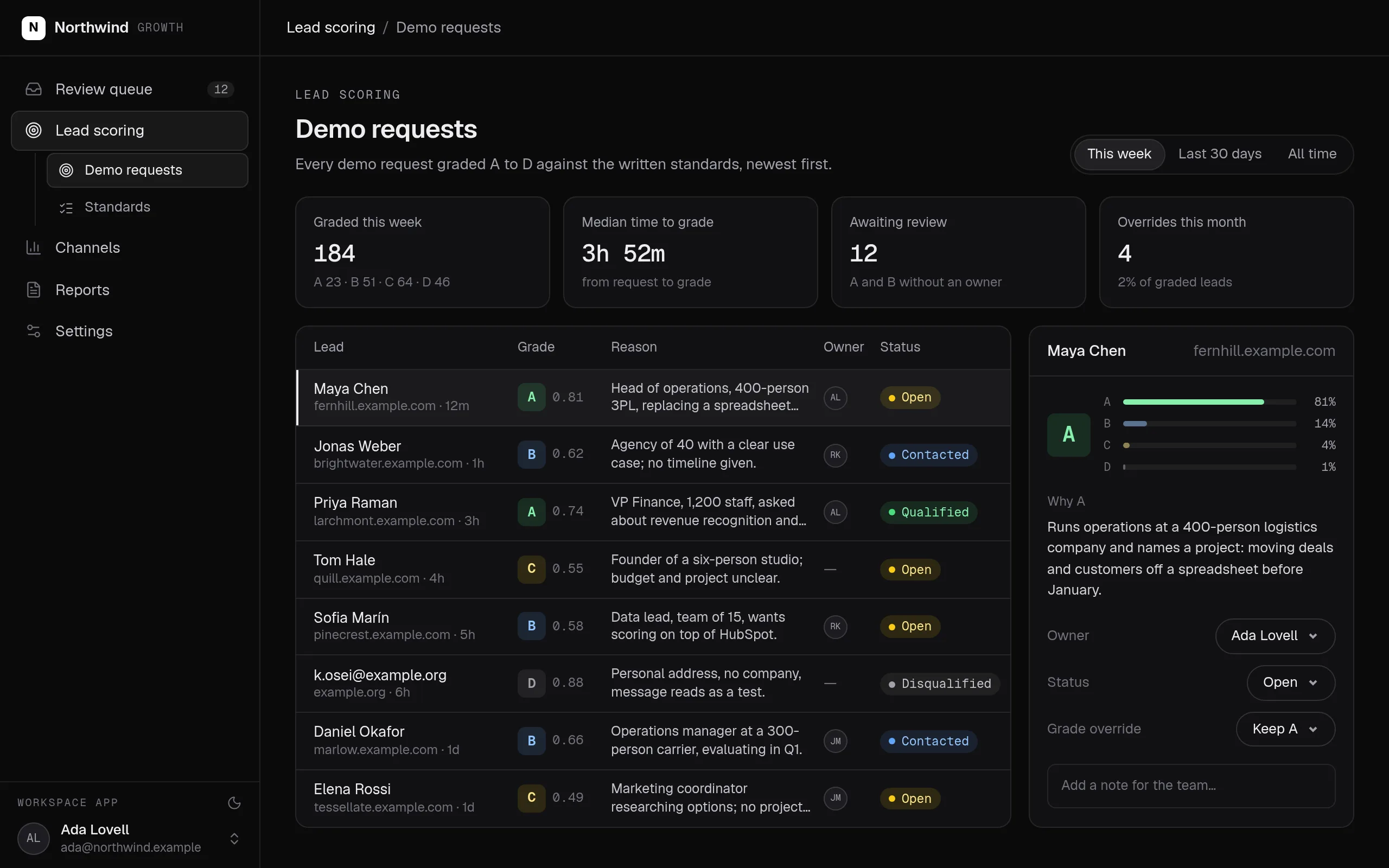
Every demo request graded A to D with the reason, the owner and where follow-up stands. Overrides and notes are records with history.
Swipe the screen sideways to see all of it.
Growth and marketing analytics: what it does
Connect HubSpot and your ad platforms, then tell your agent what a good lead looks like. It writes the pipelines, the grading standards and the review queue.
- Every demo request is graded A to D within hours by a decision model, against standards written in plain language.
- Change a standard by editing a sentence, then regrade. No training pipeline.
- The sales team can assign a lead, update its status, add notes or override a grade in the app. The original grade stays in the warehouse.
- Ad cost loads through managed connections for Google, Meta, Microsoft, LinkedIn, TikTok and X.
- Sessions come from your GA4 BigQuery export, and conversions and attribution are SQL models you can read.
What it covers
Lead scoring →
Every demo request graded A to D within hours, with a reason, against standards written in plain language.
Ad cost data
Daily ad cost from Google, Meta, Microsoft, LinkedIn, TikTok and X, modelled into one table.
Sessions and attribution →
Sessions from your own tracker or your GA4 hits, ad clicks stitched to sessions, and conversions and attribution as SQL models you can read.
Reports your team opens
Channel, campaign and lead-quality reports as pages in your own app, read by the people and agents your roles allow.
Numbers you can trust
Checks run with every pipeline run and record their result next to the table, so a broken feed shows up before a wrong report does.
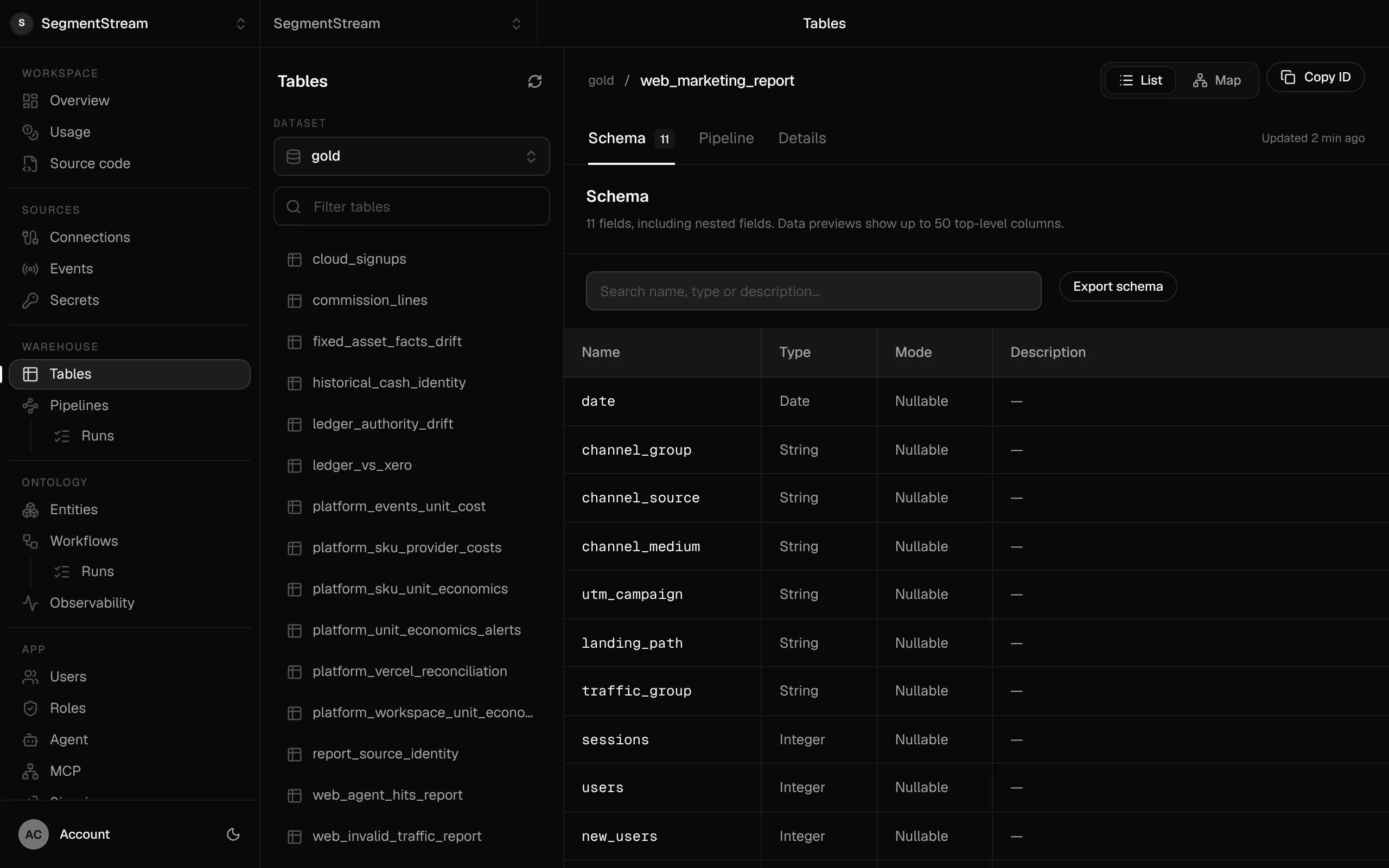
Warehouse tables your reports read.
Your reports draw sessions, channels and conversions from tables in your own warehouse.
- HubSpot score properties
- MadKudu
- custom ML scoring
- Supermetrics or Funnel cost exports
- GA4 attribution reports
Our engineers draft the grading standards from your CRM history, connect your ad platforms and GA4 export, write the models with your team, and prove the numbers before you rely on them.
Build your own from the Marketing analytics blueprint.
The Marketing analytics blueprint gives Claude Code, Codex or Cursor the design, the questions to ask you, the rules that must always hold and their tests. Paste this prompt and your agent builds your own version on SegmentStream, shaped to how your company works.
Read https://github.com/segmentstream/build-your-own/blob/main/AGENTS.md and follow it.
Build our Marketing analytics from the marketing-analytics blueprint.Enterprise, with our engineers
Our engineers draft the grading standards from your CRM history, connect your ad platforms and GA4 export, write the models with your team, and prove the numbers before you rely on them.
Self-serve, with your own agent
Connect HubSpot and your ad platforms, then tell your agent what a good lead looks like. It writes the pipelines, the grading standards and the review queue.
curl -fsSL https://segmentstream.com/install.sh | shRelated solutions
Read more
- 3 October 2026AI agents can build your BI. Here's why they get the numbers wrong.Benchmarks keep finding that agents writing SQL against raw tables give confident wrong answers, while the same agents answering through a semantic layer get nearly everything right. What that means for how you build analytics now.
- 2 October 2026How to leave GA4 without losing a single reportYou don't have to rip out gtag to own your web analytics. Change where it sends, keep GA4 running while you rebuild, and switch only when the numbers match.
- 30 September 2026The future of ad traffic verification with SegmentStream and JevAd traffic verification is still sold as a black box for $60–100k a year. The next generation runs next to your conversions, is checked against real outcomes, and is decided by a model built for decisions.
Questions
What does it cover?
Lead scoring, daily ad cost from six ad platforms, sessions from your GA4 export, and conversions and attribution as SQL models, all in your own workspace. For attribution, incrementality and budget allocation run with our experts, there is the managed Marketing Analytics service.
Where do the numbers live?
Your warehouse holds the calculated grades, ad costs and attribution results. The lead record in your app keeps the owner's name, follow-up status, notes and any grade your team overrides.
How does this relate to SegmentStream Marketing Analytics?
The managed service is SegmentStream's measurement product, run with our experts. Growth and marketing analytics on the platform is the same craft as code in your own workspace, next to your CRM and finance.
Rather have it built for you? Start a pilot.
Our engineers draft the grading standards from your CRM history, connect your ad platforms and GA4 export, write the models with your team, and prove the numbers before you rely on them.
- One solution, on your data, in your own workspace
- First version live in two weeks
- Parity proven before anything is switched off
- Fixed scope and price, credited to your contract if you continue
Not ready for a pilot? Send the form anyway with your question. An engineer will reply, not a sales rep.
How the pilot worksBuild your company’s own software. Let agents run it.
$ segmentstream workspace create acme --region eu --subdomain acme
▸ Created workspace acme · database, warehouse and a private git repository
$ segmentstream workspace WORKSPACE-ID clone acme && cd acme
▸ your coding agent builds what your team asked for and runs the checks
$ git add -A && git commit -m "First version"
$ segmentstream deploy
▸ app, company agent, API and MCP tools live for your invited members
Our engineers build the first version on your data in two weeks, at a fixed price.
Or build it yourself with your coding agent:
curl -fsSL https://segmentstream.com/install.sh | sh