AI transformation, deployed. Not advised.
Our engineers land in your company, map how the work really gets done, and move it onto one system you own: your records, rules and permissions, with agents doing the routine work and people approving the decisions. The first workflow is live in two weeks.
- Live on your data in two weeks
- Fixed scope and price to start
- Code in your own repository
The team behind SegmentStream Marketing Analytics, which built analytics for





Every company has AI pilots. Few have changed how the work gets done.
Licences get bought and pilots get demoed, then the work goes on as before. The model is rarely the problem. The agent is bolted onto processes designed for people and a dozen tools, it sees only fragments of the company, and nobody can say what it may change or check what it did.
- 01
Bolted onto old processes
The agent becomes one more step in a process designed for people and five tools. The routine stays; now it has a chatbot in it.
- 02
The company is in fragments
Customers in the CRM, money in the books, promises in inboxes and spreadsheets. Each agent sees one piece, so it can answer but can’t do the job.
- 03
No one can say what it may change
Every vendor’s agent brings its own access, and people paste data into whatever tool is to hand. Security says no, and the pilot ends there.
- 04
No one can see what it did
Without a record of which agent changed what, for whom, and whether it was right, no one hands it real work.
~6%
of organisations attribute 5% or more of their EBIT to AI.
McKinsey, The state of AI in 2026~3×
how much likelier the companies that get real value from AI are to have redesigned their workflows.
McKinsey, The state of AI in 2025>40%
of agentic AI projects will be cancelled by the end of 2027, for cost, unclear value or weak risk controls.
Gartner prediction, June 2025
We don’t add AI to your tools. We rebuild the work around one system.
Everything a team runs on moves into one company database: its records, the rules around them, the actions that change them and who may take each one. The company agent, workflows, the apps your team opens and every AI tool you use all work from it, under the same roles as your people.
Software your company runs on, safe enough to hand agents real work.
Whatever function we start with, every engagement leaves the same foundation behind: the SegmentStream platform, set up as your own workspace, with your company’s records and rules in it.
One company database
Customers, deals, contracts, invoices, orders: your records, with the rules that keep them right and the actions that change them.
Learn more →A company agent that does the work
In Slack, Teams, WhatsApp, Telegram and email. It acts with the permissions of whoever asks, and asks before changes that matter.
Learn more →Workflows for the routine
They start on a schedule or when something happens, and hand the agent the parts that need judgement.
Learn more →One door for every AI tool
Claude, ChatGPT and any MCP client reach your records through one server, each person with their own roles.
Learn more →Roles, and a history of every change
People, apps, agents and API keys are held to the same roles, and every change is kept with who made it and when.
Learn more →Code your company owns
All of it is code in a git repository that belongs to your company. Clone it, keep a copy, carry on without us.
Learn more →
Our own company database as deployed: well over a hundred entities, every relationship named, and the checks every deploy passes.
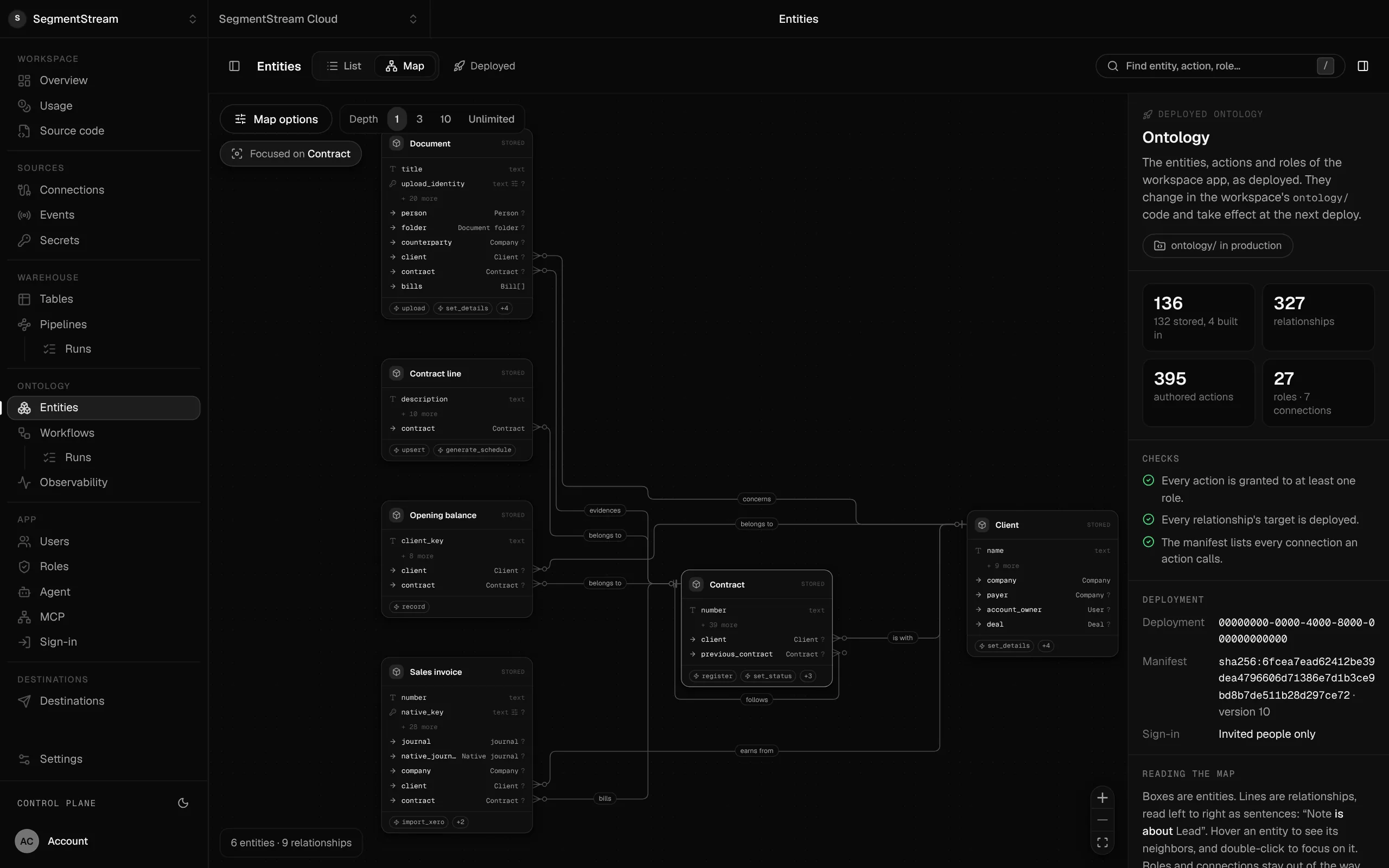
Our own workspace in the console. Every engagement leaves yours looking like this.
From the first call to a company that runs on agents.
Every engagement starts small and proves itself on your own data before it grows. One engineer owns the outcome from the first call to production: no ticket queue, no chain of hand-offs.
- 01
Week 0
Map the work
We sit with the people who do the work: what each team does every week, which tools and spreadsheets it runs through, and where a person has to decide.
You haveA map of the routine, ranked by hours, and the first workflow to move, at a fixed price
- 02
Weeks 1–2
Build the first workflow
Our engineers build it in your own workspace on your real data: the records it needs, the rules, the workflow and the agent’s part in it. You see every commit.
You haveA workflow your team uses, live in two weeks
- 03
Weeks 3–6
Run it side by side
The agent works alongside the people who did the job. We compare every outcome and explain every difference before it takes the work over.
You haveA side-by-side report, item by item
- 04
Quarter by quarter
Roll out, function by function
Finance, sales, support, operations: each team’s routine moves onto the same records and rules, and the tools it replaces are switched off once the numbers match.
You haveA scorecard of what moved and what it replaced
- 05
When you are ready
Hand it over
Everything is code in your repository, with the instructions and skills your coding agents need. Your team extends it; we stay on call or step back.
You haveYour company’s software, and the people who can change it
You decide after the first workflow. Stop, and you keep the workspace and the code. Continue, and the pilot fee is credited to your contract.
Start with one workflow →Agents earn the work. Nothing is handed over until the results match.
Agents fail quietly when nobody checks them against the people who did the job. So for the first weeks the agent works next to your team on the same items. We compare every outcome, explain every difference and fix the rule or the record behind it. The agent takes the work over only when the report is clean, and anything it is unsure of still goes to a person.
- The same items over the same period, compared one by one
- Every difference explained before anything is handed over
- Exceptions go to a person, with the reason attached
| Bank reconciliation · October | Team | Agent | Status |
|---|---|---|---|
| Bank lines matched | 1,284 | 1,284 | match |
| Matched to the same invoice or bill | 1,262 | 1,262 | match |
| Sent to a person | 22 | 22 | match |
| Coded to the same account | 1,262 | 1,259 | explained |
A transformation you can measure, because every action is on the record.
Pilots are judged on demos. A transformation is judged on the P&L. Your workspace keeps a history of every change and every workflow run, so what moved off people’s desks, what still goes to a person and which tools were switched off are counted from the record, on one page your leadership reads.
Start where the routine is heaviest.
Most companies start with one function where the work is repetitive, the rules are known and the result can be checked: finance, sales operations or support. Then the next function joins the same records.
Finance
Moves to agents
Bank reconciliation, coding bills, revenue schedules, month-end checks, chasing late payers
Stays with people
Approving journals and payments, signing off the close
See the solution →Sales
Moves to agents
Routing and scoring leads, keeping the CRM complete, follow-up reminders, pipeline reports
Stays with people
The conversations, the pricing and the deal
See the solution →Support
Moves to agents
Triage, answers from the customer’s own records, routing to the right team
Stays with people
Exceptions, refunds over a limit, unhappy customers
See the solution →Operations
Moves to agents
Order checks, stock alerts, supplier follow-ups, approval queues
Stays with people
Supplier relationships and the decisions that cost money
See the solution →Marketing
Moves to agents
Audiences, campaign preparation, cost data and reporting
Stays with people
Positioning, creative and the budget
See the solution →Management reporting
Moves to agents
Weekly numbers in the team chat, dashboards, the data behind the board pack
Stays with people
The decisions the numbers are for
See the solution →
We did it to ourselves first.
SegmentStream runs on SegmentStream. Our CRM, contracts and revenue recognition, documents and reporting live in one company database, and our company agent works in our team chats on the same records and roles. The app our team opens every day was written by agents in a week.
Before that, the same team spent ten years running data infrastructure for enterprise brands. We know where migrations break.
- entities in our company database
- 136
- actions that change them, each with its roles
- 395
- roles for people, apps, agents and API keys
- 27
- team chats our company agent works in
- 4
Deals by stage, per product, with owners and close dates. The stages are ours, and so is the rule that only sales and growth see amounts.
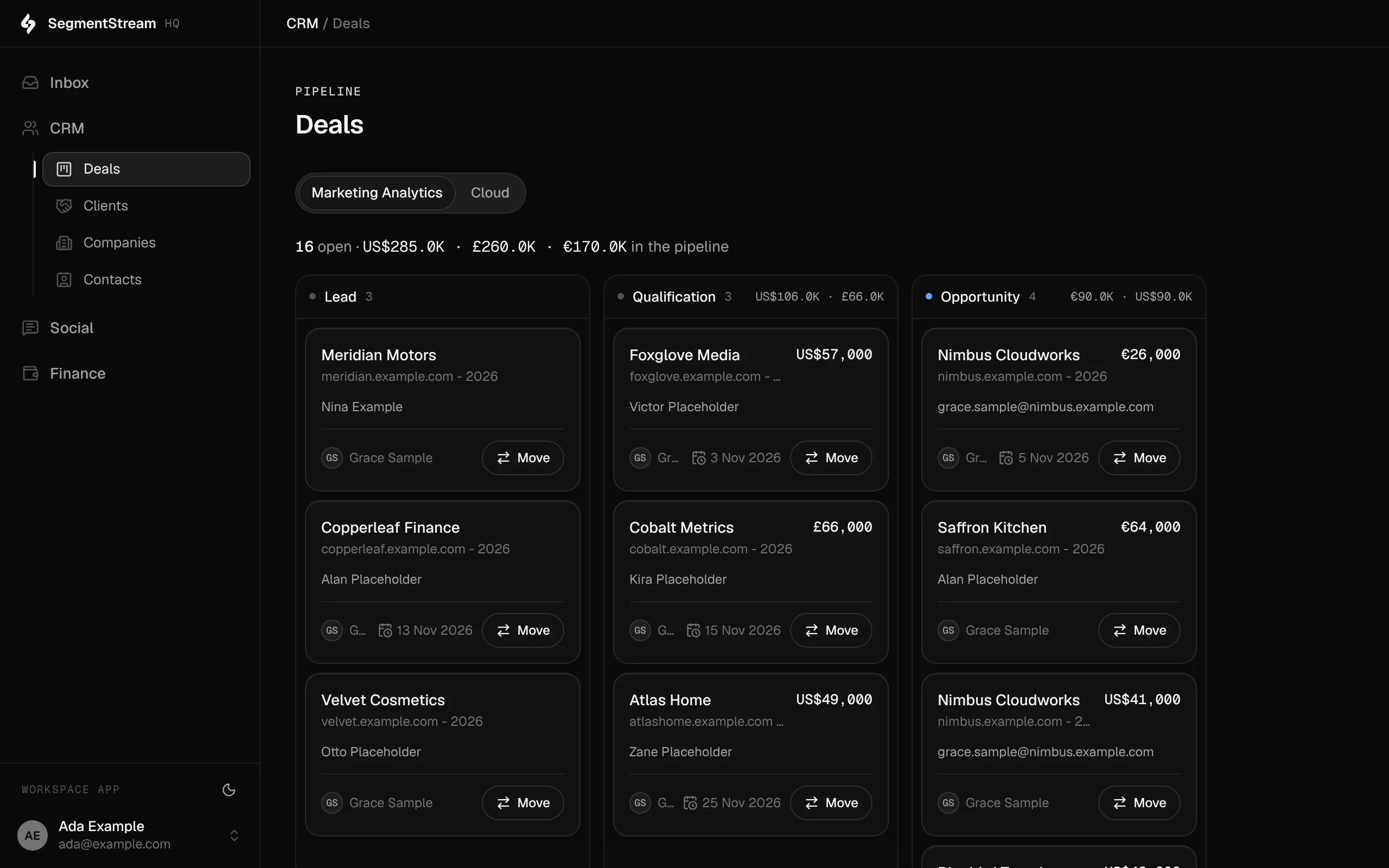
SegmentStream HQ, the app our company runs on, written by agents in a week.
Ways to run an AI transformation.
Each approach has its place. Here is what each usually leaves you with, and where we are different.
| Row | A strategy consultancy | An enterprise AI platform | Each vendor’s own agent | Building it in-house | SegmentStream |
|---|---|---|---|---|---|
| What you have at the end | A strategy consultancyA strategy, a roadmap and a business case | An enterprise AI platformApplications on the vendor’s platform | Each vendor’s own agentAn agent inside each tool | Building it in-houseWhatever your engineers have time to build | SegmentStreamOne system your company runs on, with agents doing the routine work |
| First workflow in production | A strategy consultancyAfter the roadmap, usually through an integrator | An enterprise AI platformFast, on the vendor’s platform | Each vendor’s own agentFast, inside one tool | Building it in-houseWhen the foundations are built | SegmentStreamTwo weeks, on your own data |
| Access and audit across tools | A strategy consultancyRecommended, built by someone else | An enterprise AI platformInside the vendor’s platform | Each vendor’s own agentSeparate in every tool | Building it in-houseSign-in, roles, history and secrets built from scratch | SegmentStreamOne set of roles and one history for people, apps, agents and API keys |
| Who owns it afterwards | A strategy consultancyDepends on the integrator’s contract | An enterprise AI platformIt runs inside the vendor’s platform | Each vendor’s own agentEach vendor | Building it in-houseYou | SegmentStreamYou: code in your own repository, on open standards |
For the people who own the result.
Founders and CEOs
Your board asks what AI is doing for the business. You want the company to run on it, not another pilot to present.
COOs and operations leaders
The routine lives across teams and tools. You want it done the same way every time, with the exceptions coming to a person.
CFOs and finance leaders
You need cost out, a faster close and controls an auditor accepts: who did what, when, under which role.
Heads of AI and transformation
You have pilots and licences. You need production, an access model security signs off, and numbers that show it worked.
How engagements are priced.
Every engagement starts with a fixed-scope first workflow, at a price agreed in writing. After that, the programme is scoped and priced with you, function by function, and platform usage is billed as in self-serve: you pay for what runs, with no seats.
See pricing →- A fixed-scope first workflow, credited to your contract if you continue
- Forward-deployed engineers for the whole programme
- Side-by-side reports before any work is handed over
- A scorecard of what moved and what it replaced
- Roles and permissions for people, API keys and agents
- EU or US data residency, isolated workspaces
- Support with agreed response times
- Stop at any point and keep the workspace and the code
What founders ask before they start.
What does an AI transformation partner do?
It changes how the work in your company gets done, not just which tools you use. We map each team’s routine, move it onto one system your company owns, let agents do the repetitive parts and route decisions to people, then measure what moved. Our engineers build it with your team and hand it over as code.
How is this different from hiring a consultancy?
A consultancy usually delivers a strategy and a roadmap, and someone else builds it. Our engineers build from the first week: the first workflow is live on your data in two weeks, and the roadmap is written from what has already worked.
Do we have to replace the tools we use today?
No. Tools you keep are connected, with credentials held by the platform. We replace a tool only where running that part of the company on your own records pays off, and nothing is switched off until the old and the new agree.
What happens to our team?
The routine moves to workflows and the agent; people keep the decisions, the exceptions and the customers. We also train the people who will extend the system after we leave, with the coding agents they already use.
How long does it take?
The first workflow is live in two weeks and runs side by side with your team for a few weeks after that. Then functions join one at a time, usually a quarter each, at the pace your company can take.
Are we tied to one AI model or vendor?
No. Your team builds on the workspace with Claude Code, Codex or Cursor, and Claude, ChatGPT and other MCP clients reach your records with each person’s own roles. The code is yours, in your repository.
Where does our data live?
In an isolated workspace in the EU or the US. Credentials for the tools you connect are held by the platform and never reach your code.
Who owns what you build?
You do. Every app, the company database, workflows, pipelines and the agent are code in a git repository that belongs to your company. If you stop, you keep the workspace and the code.
Start with one workflow.
Tell us what your teams spend their week on and what it runs on today. Your note goes straight to our founder, and the first call ends with the first workflow to move, what success looks like and a fixed price.
- One solution, on your data, in your own workspace
- First version live in two weeks
- Parity proven before anything is switched off
- Fixed scope and price, credited to your contract if you continue
Not ready for a pilot? Send the form anyway with your question. An engineer will reply, not a sales rep.
How the pilot worksPrefer to build it yourself? Start with your own agent.
Build it yourself with your coding agent:
curl -fsSL https://segmentstream.com/install.sh | sh