Everything your company’s software needs, and the agent that runs it.
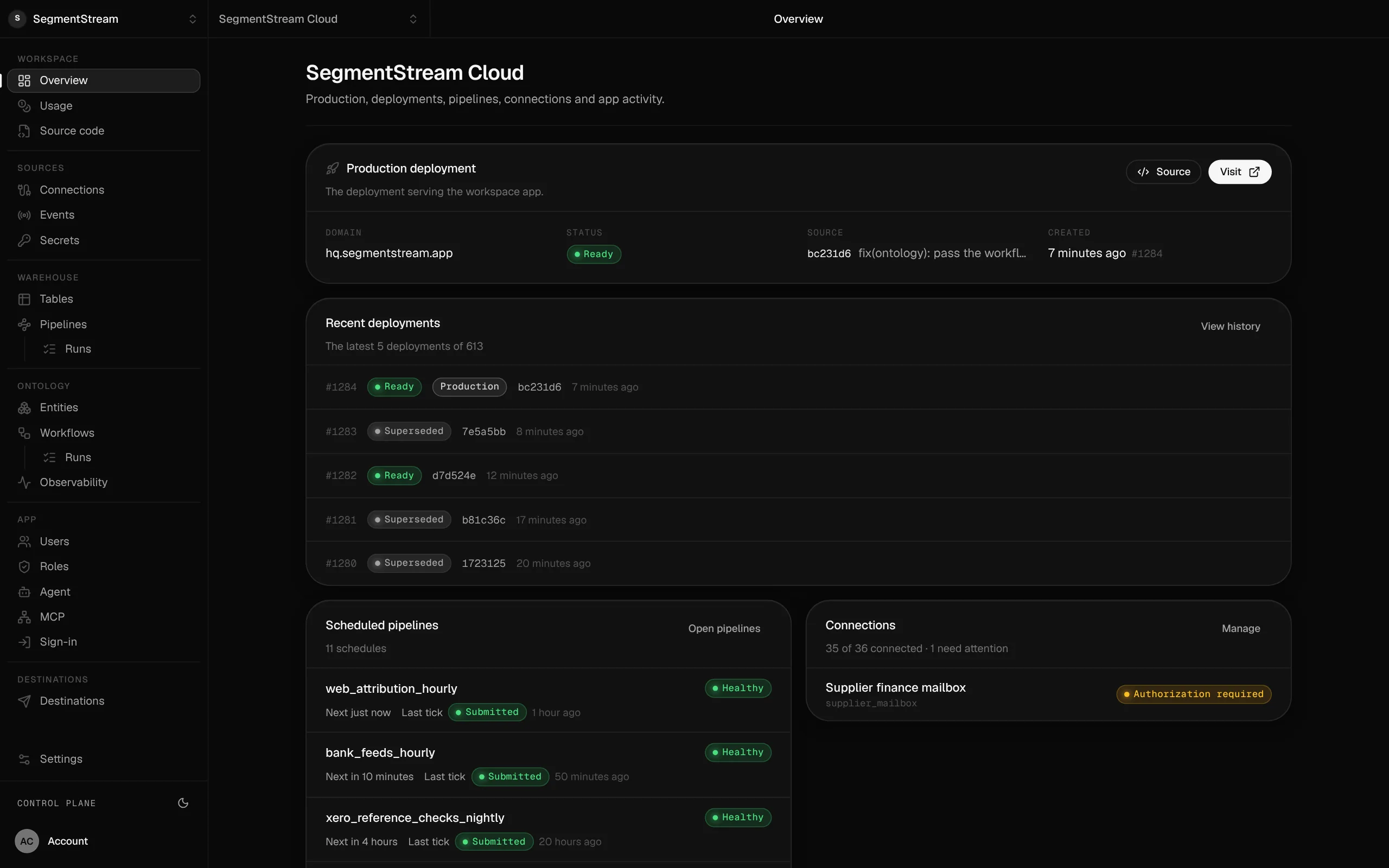
One platform for the software your company runs on: a database with your rules, the apps your team opens, workflows, your data and integrations, and a company agent that does the routine work. Your coding agent builds on it, or our engineers build it with you. Every app starts ready for production.
Every vendor sells an agent. Few companies can let one work.
Agents are being bolted onto legacy software and scattered data: the CRM in one place, the books in another, spreadsheets and inboxes in between. The agent sees fragments, every tool has its own permissions, and nobody can say what it may change. It can answer, but you can’t hand it the work.
One database with your rules
Your customers, deals, invoices and orders, the actions that change them, who may take each one, and the history of every change. Every app and agent works on the same records.
Software your team opens
The CRM, the back office and the dashboards your team opens, built around how you work, ready for production from the first deploy: sign-in, roles and history included.
An agent you can let work
A company agent in Slack, Teams, WhatsApp, Telegram and email that acts as the person asking, asks before it changes anything that matters, and runs routine work on a schedule.
What the platform gives your company
Start from the system, not the agent. Each part shares the same records, rules and permissions, so whatever you build next works with what is already there.
One workspace per company: your software in a repository you own, a console to see it, one deploy.
Your records and the rules for changing them, open to your apps, your team’s AI tools and the company agent.
The tools your team opens, and a company agent that does the routine work in your team’s chats and inbox.
Work that starts on its own: on a schedule, when something happens, or when a record changes.
Data from every tool, modelled and checked in your own warehouse.
Every tool you keep, connected once, with its credentials held by the platform.
Your company's software, in a repository you own.
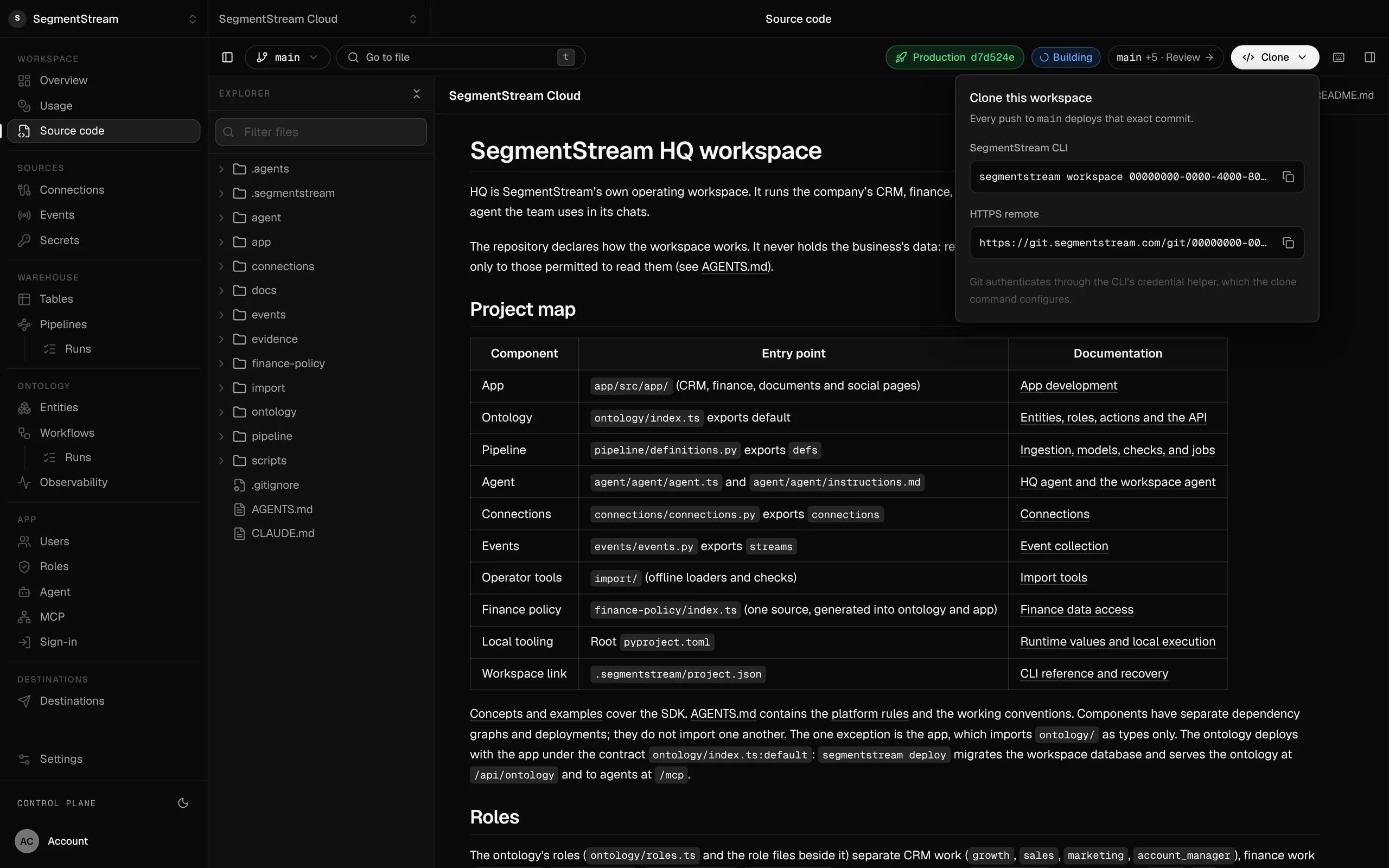
Every workspace owns a private git repository with the five folders and their full history. Clone it with plain git, keep a copy on GitHub, take it with you. segmentstream deploy, or a push to main, deploys that exact commit. If a deploy fails, production keeps serving the last good one.
One repository, one workspace
Commit, then deploy
$ segmentstream workspace WORKSPACE-ID clone acme$ cd acme# Your agent edits the folders; you review the diff.$ git add -A && git commit -m "Add contract approvals"$ segmentstream deployThe deploy checks every folder first: the ontology's changes are planned against the live database and tried on a copy, and unsafe changes are refused before anything applies.
The data stack is one layer of it.
A typical company pays for seven data tools and the engineers who glue them together, and the numbers still drift between them. On SegmentStream the data stack is one layer of the infrastructure your software runs on: pipelines, a warehouse and checks, in the same repository as your apps and your company database.
Before: the patchwork stack
~$210k/yr · 7 contracts · 2 data engineers · T+ 6 months
Typical mid-market list prices.
After: one platform
Company database
Apps and agent
Workflows
Data
Integrations
Usage-based · 1 contract · first version in two weeks
Enterprise, with our engineers
Our engineers build the software your teams need in your own workspace, or move over what you run today, as code you own. It starts with a fixed-scope pilot.
Self-serve, with your own agent
Install the CLI and tell your coding agent what your team needs. It creates the workspace, builds on the platform and deploys. You pay only for what runs.
curl -fsSL https://segmentstream.com/install.sh | shBuild your company’s own software. Let agents run it.
$ segmentstream workspace create acme --region eu --subdomain acme
▸ Created workspace acme · database, warehouse and a private git repository
$ segmentstream workspace WORKSPACE-ID clone acme && cd acme
▸ your coding agent builds what your team asked for and runs the checks
$ git add -A && git commit -m "First version"
$ segmentstream deploy
▸ app, company agent, API and MCP tools live for your invited members
Our engineers build the first version on your data in two weeks, at a fixed price.
Or build it yourself with your coding agent:
curl -fsSL https://segmentstream.com/install.sh | sh