
The Klaviyo alternative you own: your customers, your flows, no bill per profile.
Profiles, consent, orders and events in a workspace you own, beside your store. Your agents build the segments and flows, your team approves them, and every email and text goes out through the providers you choose, with no charge per profile. We do the whole move off Klaviyo for you, side by side, until each flow matches.
- First version in two weeks, at a fixed price
- Consent keeps its original dates
- Klaviyo keeps sending until each flow has switched
- No charge per profile
SegmentStream replaces Klaviyo's profiles, consent, segments and flows with a workspace you own, next to your store's orders. Your agents build segments and flows, your team approves them, and every email and text goes out through the providers you choose, with no charge per profile. Keep Klaviyo if your team lives in its drag-and-drop editor and wants one tool for everything; move if you want your customer data, your flows and your attribution in your own hands. We do the whole move for you, side by side, until each flow matches.
Stay on Klaviyo if
- Your team builds every email in a drag-and-drop editor and wants to keep it.
- You rely on Klaviyo Reviews, Customer Hub or its sign-up form builder.
- You would rather not hold accounts with your own sending services.
Move to SegmentStream if
- Your Klaviyo bill grows with your list faster than with your revenue.
- You want orders, events, consent and flows in your own warehouse, beside the rest of the business.
- You want email and SMS measured with the same attribution as your ads, not by Klaviyo's own credit.
- You want your agents to draft segments and flows, and your team to approve them.
We move you, if you want
Our engineers model your profiles and consent, take your profiles, events and suppressions out of Klaviyo, connect your store, rebuild segments and flows, connect your senders and run both side by side until each flow matches. It starts with a fixed-scope pilot.
Request a pilot →Last reviewed November 2026 · Sources: Klaviyo: FAQ, Feb 18 billing changes, How Klaviyo pricing works, Klaviyo Get Profiles endpoint
Klaviyo bills every profile it can email. Your list grows, and so does the plan.
Since 18 February 2025 Klaviyo has priced its email plans on active profiles: every profile that can receive email through Klaviyo, whether or not that person has opened, clicked or bought. When the count passes the plan's limit, a paid plan moves up to the tier that covers it at the next billing cycle. Unsubscribed and suppressed profiles do not count. On 13 July 2026 text messaging moved from credits to per-message rates in dollars, for paid accounts from their first billing cycle after 13 August 2026.
- A profile counts as soon as it can receive email, so collecting customers raises the bill even when you send no more.
- The usual way to stay in a tier is to suppress the people who have not engaged, which means mailing fewer of your own customers.
- On your own stack a profile that receives nothing costs only its storage. You pay your providers per message and the platform for what runs.
- Your profiles, consent history and flows are the most valuable part of the account. Owning them makes the next renewal a choice.
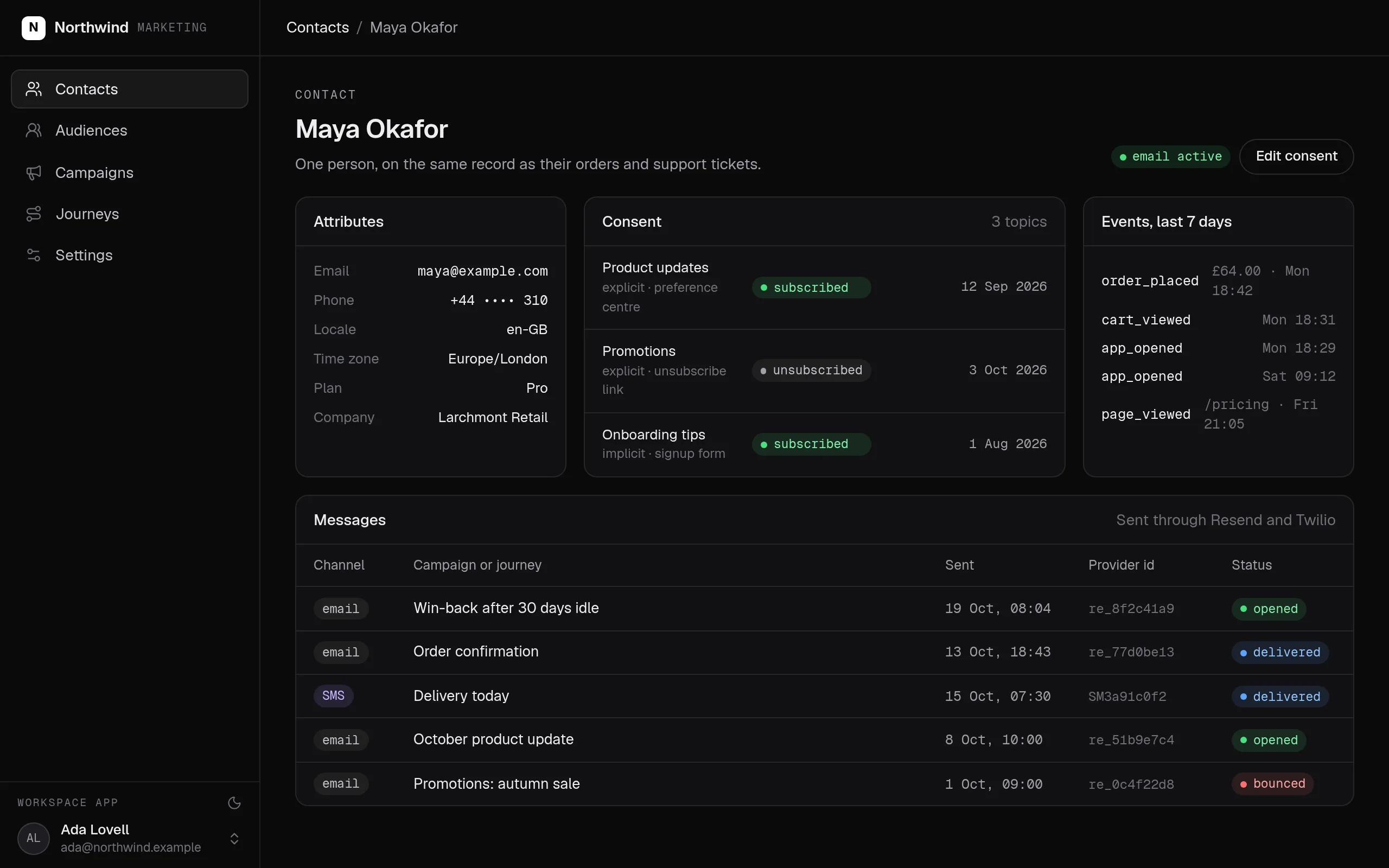
One person: attributes, consent per topic with date and source, the events they sent and the messages they received, on the same record as their orders and support tickets.
Swipe the screen sideways to see all of it.
What comes over, and what stays
What you bring from Klaviyo, and what you keep in the tools you like.
- Profiles and their custom properties
- Email and SMS consent, with Klaviyo's consent dates and methods
- Suppressions: unsubscribed, bounced and marked as spam
- Event history such as Placed Order, Started Checkout and Viewed Product, through Klaviyo's API
- Orders and customers, straight from your store
- Lists and segments, rebuilt and compared with Klaviyo's counts
- Flows, rewritten one at a time, and your templates as code
- Your sending services: every email and text goes out through them, not through servers of ours
- A drag-and-drop email editor: your agent writes the templates and your team reviews them
- Product reviews, loyalty and a customer portal, in the tools you choose for them
What the Klaviyo alternative does
Your team keeps every flow and campaign it runs today, from welcome and abandoned checkout to win-back, now on customer data you own beside your orders. Email and SMS are measured with the same attribution as your ads, and your list can grow without moving you up a tier.
- Every shopper in one place: profile, email and SMS consent, orders, checkouts and the messages they received, beside their support tickets.
- Consent is a record per person, channel and topic, kept with the date and method of every change.
- Segments are models over your own orders and events, checked on every run: lapsed buyers, VIPs, likely to churn.
- Flows run on their own: a store webhook, a schedule or a record change starts them, and they wait, check for an order and consent, and send.
- Plug in the sending services you choose, and every email and text goes out through them from your own domain and number.
- Email and SMS revenue is measured with the same attribution as your ads, in your own warehouse.
- No charge per profile: you pay for what runs, and your providers bill their own sending.
What it covers
Every shopper, one profile you own →
Contacts with their properties, email and SMS consent per topic with its date and method, linked to their orders, checkouts and support tickets. Bounces, spam complaints and unsubscribes are recorded on the contact.
Store and site events you keep →
Orders and checkouts from Shopify or your own back end, product views from your site's event stream, all in tables in your own warehouse, with their full history.
Segments you can check →
Lapsed buyers, VIPs, likely to churn: segments are models over your own orders and events, checked on every run. Compare their counts with Klaviyo side by side before a single send depends on them.
Flows that run themselves →
Welcome, abandoned checkout, browse abandonment, post-purchase and win-back run as workflows: a store webhook, a schedule or a record change starts them, and they wait, check for an order and consent, then send. Your agent drafts them from a brief and your team approves.
Any sender, no bill per profile →
Connect the services you prefer, such as Amazon SES, Resend, SendGrid, Postmark, Twilio or WhatsApp, and every email and text goes out through them from your own domain and number. No profile tiers: your providers bill their sending at their own rates.
Email revenue on the same scale as ads →
Klaviyo credits revenue to its own messages by its own rules. In your workspace every order is attributed across email, SMS and paid channels with one model, so each channel is judged on the same scale.
Plug in any sending service. Everything goes out through it.
Campaigns, journeys, transactional and triggered messages, run by your agents and workflows on your own data, all go out automatically through the sending services you choose. You keep their deliverability: your domain, SPF, DKIM and DMARC, and dedicated IPs if you have them. And you are never locked into one vendor's sender.
- Amazon SES
- Resend
- SendGrid (Twilio)
- Mailgun
- Postmark
- SparkPost
- Brevo
- Mailchimp Transactional (Mandrill)
SMS
- Twilio
- Vonage
- Sinch
- Plivo
- Bird (MessageBird)
- WhatsApp Business Platform (Meta Cloud API)
- Twilio for WhatsApp
Push
- Firebase Cloud Messaging
- Apple Push Notification service
- OneSignal
Connect any sending service you like, such as Amazon SES, Resend, SendGrid, Postmark, Twilio or OneSignal. SegmentStream sends every campaign, journey and transactional message through it from your own domain, and we set it up with you.
Every Klaviyo concept, and where it lives in your workspace
For your engineers: every Klaviyo concept and where it lives once you have moved.
| In Klaviyo | In your workspace | What to know |
|---|---|---|
| Profiles and custom properties | contact entity with typed properties and history | Loaded once through the ontology API; properties keep their names |
| Email and SMS consent | subscription per contact, channel and topic | Klaviyo's consent timestamps and methods are kept |
| Suppressions | emailStatus on the contact | The send action refuses a suppressed address, whoever sends |
| Metrics: Placed Order, Started Checkout, Viewed Product | Orders and checkouts from your store; site events through an event stream | In tables you own, with history loaded from Klaviyo's API |
| Lists | Audiences over your contacts | Membership imports onto the contacts |
| Segments | SQL models with checks, plus audience definitions | Sizes compared with Klaviyo before any send depends on them |
| Flows | Workflows in ontology/workflows/ | Started by a store webhook, a schedule or a record change; they wait, check and send |
| Campaigns | campaign and message entities with a send action | Approved by the role you choose; consent is checked inside the action |
| Templates and the email editor | Templates in code or in your email provider | Written by your agent, reviewed by your team |
| Sign-up forms | Forms on your site that call a subscribe action | Consent recorded with its date and source |
| SMS and WhatsApp | The providers you choose: Twilio, Vonage, Sinch or WhatsApp | Billed by your provider, per message |
| Predictive analytics: lifetime value, churn risk | Models in your pipeline, and decision models for scoring | Your definitions, readable and changeable |
| Attributed revenue | Attribution across email, SMS and ads in your warehouse | One model for every channel |
| Klaviyo AI | Any agent over MCP, as the member it works for | Under your roles, with every change recorded |
What you bring, and what SegmentStream does not do
- An account with each sending service you use. SegmentStream does not run its own mail servers or SMS gateways; it sends through yours.
- A drag-and-drop email editor. Templates are written by your agent and live in code or in your email provider.
- Product reviews, loyalty and a customer portal. Keep the tools you use for them, or build what you need on the same records.
- A one-click store app. Your store connects with an API token and its webhooks, set up with you.
How a migration from Klaviyo works
We do every step for you, or your team does it with its own agent and our engineers on call. Klaviyo keeps sending until each flow has switched.
- 01
Model who you message, and about what
The contact, subscription, checkout, order, audience, campaign and message entities are written with your properties, your topics and your consent rules, and the roles that may change them. The result is a pull request you read.
- 02
Take your data out of Klaviyo
Profiles load with their email and SMS consent, keeping Klaviyo's consent timestamps and methods. Events come out metric by metric through Klaviyo's API, and suppressions import onto the contacts. Klaviyo keeps running throughout.
- 03
Connect the store and the site
Orders, checkouts and customers come from your store's API with their full history, and its webhooks reach your workflows. Your site sends product views and sessions into an event stream you own.
- 04
Rebuild segments as models
Each Klaviyo segment becomes a SQL model with a check on every run, and an audience definition over your contacts. Sizes are compared with Klaviyo side by side; a difference is explained, not ignored.
- 05
Rewrite flows, connect your senders
One flow at a time becomes a workflow, welcome and abandoned checkout first. Your email and SMS providers are connected for you, and your templates move into code your agent maintains.
- 06
Switch a flow when it matches
Both systems run through a full cycle, every send and order is compared, and a flow moves only when its numbers match. Klaviyo stays until your contract says otherwise.
We move you off Klaviyo, end to end, if you want us to.
Our engineers model your profiles, consent and topics with your lifecycle team, take your profiles, events and suppressions out of Klaviyo, connect your store, rebuild your segments and the flows that matter, connect the senders you choose, and run both systems side by side until each flow matches. Or do it with your own agent and our help on call.
Nothing switches until the numbers match.
Both systems run side by side. Every number your teams rely on is compared, and every difference is explained before anything is turned off.
| Metric | Klaviyo | Workspace | Status |
|---|---|---|---|
| Active profiles | 184,326 | 184,326 | match |
| Email consent: subscribed | 121,904 | 121,904 | match |
| Segment: lapsed 90 days | 12,418 | 12,409 | explained |
| Abandoned checkout, week 1 sends | 2,914 | 2,914 | match |
| Placed orders, October | 18,602 | 18,602 | match |
- Klaviyo flows and segments
- Mailchimp
- Omnisend
- Drip
- Attentive and Postscript for SMS
Klaviyo keeps sending while you move. Profiles and consent come over with Klaviyo's consent dates, events through its API, and orders straight from your store. Each segment is rebuilt and compared with Klaviyo's count, flows are rewritten one at a time, starting with welcome and abandoned checkout, and email and SMS go out through the providers you choose. A flow switches when its numbers match, and nothing is switched off before that. We do the whole move for you if you want: see the offer below.
Enterprise, with our engineers
Our engineers model your profiles, consent and topics with your lifecycle team, take your profiles, events and suppressions out of Klaviyo, connect your store, rebuild your segments and the flows that matter, connect the senders you choose, and run both side by side until each flow matches.
Self-serve, with your own agent
Connect your store and your senders, then tell your agent who you message, about what, and who approves. It writes the contacts, consent, segments, the send action and the first flow, and segmentstream deploy gives you the app, the API and the MCP tools.
curl -fsSL https://segmentstream.com/install.sh | shRelated solutions
Questions
Is SegmentStream a Klaviyo alternative?
Yes, for what matters most: your profiles, consent, orders, events, segments and flows live in a workspace you own, and your agents and your team run campaigns from it. Every email and text goes out through the sending services you choose, such as Amazon SES, Resend, SendGrid, Postmark or Twilio, and there is no charge per profile.
Do we keep Shopify?
Yes. Your store stays as it is. Orders, checkouts and customers come from Shopify's API, and its webhooks start the flows that must react to a checkout or an order. Product views come from your site through an event stream. WooCommerce, BigCommerce and custom back ends connect the same way.
Which email and SMS services can we use?
Any of them: Amazon SES, Resend, SendGrid, Mailgun, Postmark, SparkPost or Brevo for email; Twilio, Vonage, Sinch, Plivo or Bird for SMS; the WhatsApp Business Platform. We set up whichever you use as part of the migration.
Can we migrate from Klaviyo without losing data?
Profiles load with their email and SMS consent, including Klaviyo's consent timestamps and methods, from its Profiles API. Events come out metric by metric through its Events API, or through the bulk export jobs Klaviyo opened to allow-listed accounts in 2026. Suppressions import onto the contacts, and orders reload straight from your store with their full history.
How do flows work without Klaviyo's flow builder?
A flow is a workflow file in your repository: steps that wait, check for an order and for consent, and send through your provider, started by a store webhook, on a schedule or when a record changes. Your agent writes it from a plain-language description, your team reviews the pull request, and every run and step is recorded.
How is email and SMS revenue measured?
Klaviyo reports the revenue it credits to its own messages. In your workspace, orders, sessions, email and SMS clicks and ad spend sit in one warehouse, and attribution is a model you can read, applied to every channel the same way. That is ten years of SegmentStream measurement, on your own data.
Who handles deliverability?
Your providers and your authenticated domain: SPF, DKIM and DMARC, and dedicated IPs if you have them. We configure them with you during the migration. The workspace keeps the suppression truth: a bounced, complained or unsubscribed address is recorded on the contact and the send action refuses it, whoever or whatever is sending.
How long does a Klaviyo migration take?
Our engineers put the first version in your workspace in two weeks at a fixed price, usually profiles, consent, the store connection and the welcome and abandoned checkout flows. Each further flow and campaign switches when its numbers match Klaviyo's through a full cycle. Nothing is switched off before that.
What does it cost to run?
Usage: compute in SSU, storage, warehouse queries, events, data transfer and AI models at list price plus 15%. No seats, no feature gates and no tiers by profile count. Your providers bill their own sending per message, as they publish it.
We are an agency running Klaviyo for clients. Does this work for us?
Yes. Each client's profiles, orders and flows live on the client's own records, sent through the client's own providers, and your team reuses the same flows and segments from one client to the next. See our page for marketing agencies.
Who owns the code and the data?
You do. The code lives in a private git repository for your workspace; clone it with plain git, keep a copy on GitHub, take it with you. The database and the warehouse are yours, with no limit on API calls and full agent access within the roles you give. SegmentStream runs it.
Rather have it moved for you? Request a pilot.
Our engineers model your profiles, consent and topics with your lifecycle team, take your profiles, events and suppressions out of Klaviyo, connect your store, rebuild your segments and the flows that matter, connect the senders you choose, and run both side by side until each flow matches.
- One solution, on your data, in your own workspace
- First version live in two weeks
- Parity proven before anything is switched off
- Fixed scope and price, credited to your contract if you continue
Not ready for a pilot? Send the form anyway with your question. An engineer will reply, not a sales rep.
How the pilot worksBuild your company’s own software. Let agents run it.
$ segmentstream workspace create acme --region eu --subdomain acme
▸ Created workspace acme · database, warehouse and a private git repository
$ segmentstream workspace WORKSPACE-ID clone acme && cd acme
▸ your coding agent builds what your team asked for and runs the checks
$ git add -A && git commit -m "First version"
$ segmentstream deploy
▸ app, company agent, API and MCP tools live for your invited members
Our engineers build the first version on your data in two weeks, at a fixed price.
Or build it yourself with your coding agent:
curl -fsSL https://segmentstream.com/install.sh | sh