Pipelines your agent can write and you can read.
Connections, ingestion, models, checks, schedules and AI evaluation in plain Python, in the pipeline/ and connections/ folders. The platform validates the graph, runs it on managed compute and shows the lineage of every table.
Get started
# pipeline/pyproject.tomldependencies = ["segmentstream-pipeline[bigquery]"]At a glance
- Python, with Ibis models compiled to warehouse SQL
- Bronze, silver and gold tiers; daily partitions; backfills
- Assets, checks, jobs and schedules in one definitions file
- 24 ready-made connections, plus any API with a key, OAuth 2.0 or client credentials
What it does
Connections
Declare connections once; pipelines, ontology actions and the company agent share them. OAuth tokens and keys stay with the platform.
from segmentstream.connections import GoogleAdsConnection, HubSpotConnectionconnections = ( GoogleAdsConnection(key="google_ads"), HubSpotConnection(key="hubspot"),)Ingestion
Load any source by day, with backfills. Re-running a day replaces it exactly.
@s.ingestion( tier=s.Tier.Bronze, partitioning=s.Partitioning.Daily(column="order_date", start_date="2026-01-01"), schema={"order_id": "string", "order_date": "date", "amount": "float64"}, primary_key=("order_id",),)def raw_orders(context: s.Context) -> Iterator[s.IngestionRow]: for day in context.partition_keys: yield from fetch_orders(day)Models
Models are dataframe expressions compiled to warehouse SQL, with declared schemas and inputs resolved by name.
@s.model( tier=s.Tier.Gold, partitioning=s.Partitioning.Daily(column="order_date", start_date="2026-01-01"), schema={"order_date": "date", "customer_count": "int64", "total_revenue": "float64"},)def revenue_summary(customer_revenue: ir.Table) -> ir.Table: return customer_revenue.group_by("order_date").aggregate( customer_count=customer_revenue.count(), total_revenue=customer_revenue.revenue.sum(), )Checks
Checks evaluate a table and record the result next to it, where lineage and agents can see it.
@s.asset_check(asset=raw_orders)def positive_order_amounts(raw_orders: ir.Table, warehouse: s.WarehouseResource) -> s.CheckResult: invalid = int(warehouse.execute(raw_orders.filter(raw_orders.amount <= 0).count())) return s.CheckResult(passed=invalid == 0, metadata={"invalid_order_count": invalid})Jobs and schedules
Jobs select assets; schedules run them from code, in a timezone, over the partitions you name.
revenue = s.job("revenue_pipeline", assets=[revenue_summary], include_upstream=True)defs = s.definitions( assets=[raw_orders, revenue_summary], checks=[positive_order_amounts], jobs=[revenue], schedules=[ s.schedule( "revenue_morning", job=revenue, cron="0 6 * * *", timezone="Europe/London", partitions=s.LatestPartitions(3), ), ],)AI evaluation
Ask a decision model typed questions about any record and store the answers, with their probabilities, next to it.
client = s.evaluation_client("evaluation")result = client.evaluate( state={"job_title": "Head of Learning & Development", "company": "Acme"}, questions={ "relevant": { "type": "boolean", "instructions": "Would sales accept this demo request as an opportunity?", }, },)relevant = result["answers"]["relevant"]["probability"]What the Pipeline SDK builds.
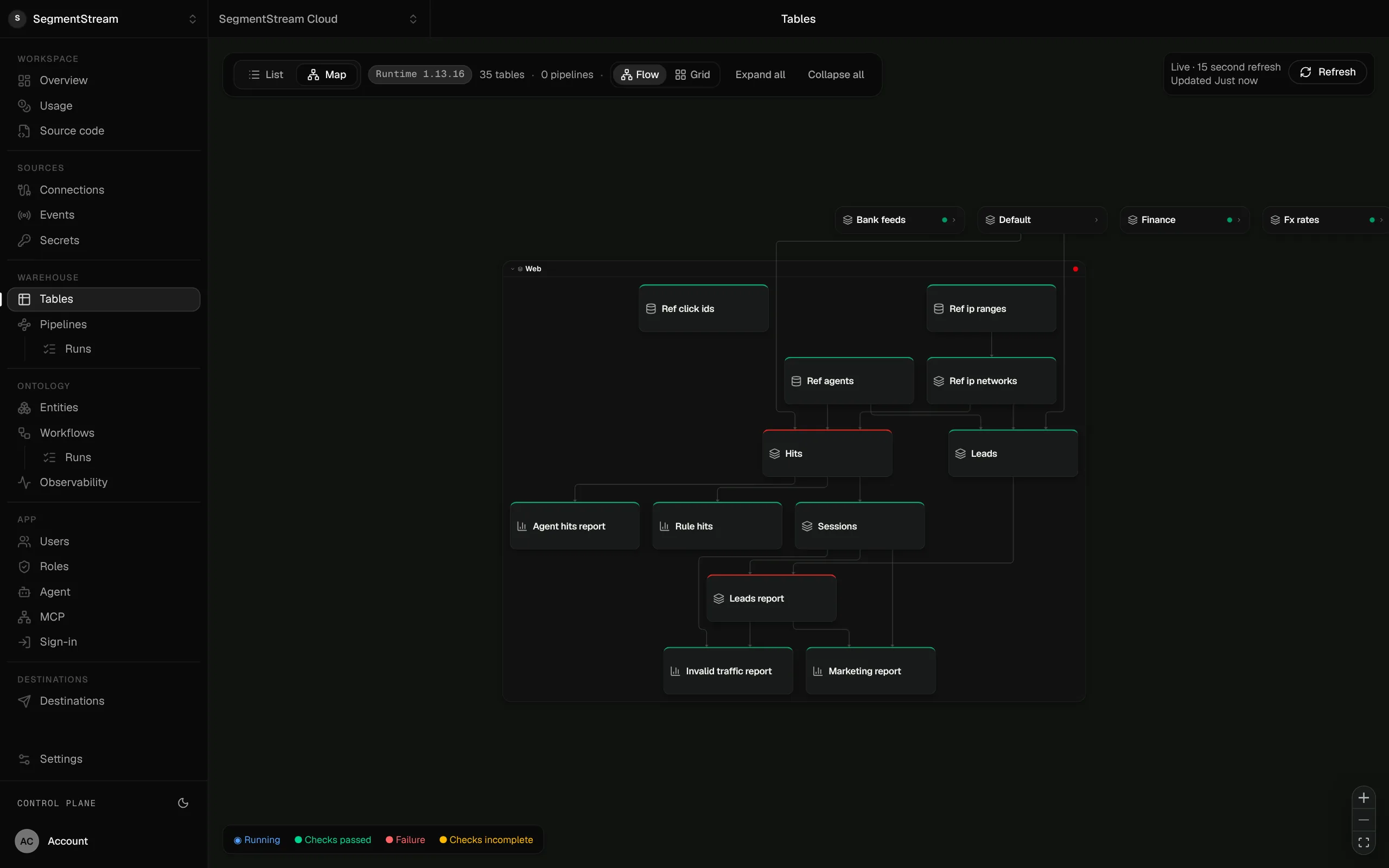
Ingestion and models from pipeline/, as a map of what feeds what, with the state of every table's checks.
The rest of the surface
Ontology SDK
@segmentstream-cloud/ontology
Entities, actions and roles; REST, OpenAPI and MCP from one model
App SDK
@segmentstream-cloud/app
Email-code sign-in, roles, records and warehouse data for Next.js
Agent SDK
@segmentstream/agent
The company agent: ontology tools as the member, in your team’s channels
CLI
segmentstream
Workspaces, deploys, members, jobs and data from the terminal
MCP and API
/mcp and /api/ontology on every app
REST, OpenAPI and MCP on every app, per caller
Build your company’s own software. Let agents run it.
$ segmentstream workspace create acme --region eu --subdomain acme
▸ Created workspace acme · database, warehouse and a private git repository
$ segmentstream workspace WORKSPACE-ID clone acme && cd acme
▸ your coding agent builds what your team asked for and runs the checks
$ git add -A && git commit -m "First version"
$ segmentstream deploy
▸ app, company agent, API and MCP tools live for your invited members
Our engineers build the first version on your data in two weeks, at a fixed price.
Or build it yourself with your coding agent:
curl -fsSL https://segmentstream.com/install.sh | sh