
SegmentStream vs Zapier
Zapier connects 9,000+ apps so you can build AI workflows, agents and apps without code. SegmentStream is where the work itself lives: your company’s records and rules, the workflows that change them, integrations and a company agent, written as code in a repository you own. Zapier can start a SegmentStream workflow when something happens in another app.
- Choose Zapier when
You need quick connections between the SaaS tools you already use, built by people who don’t write code.
- Choose SegmentStream when
The process is part of how the company runs: it changes your own records, needs rules and approvals, should be versioned and tested, and an agent should be able to run it.
- Use both when
Zapier passes events from the tools you keep into SegmentStream workflows through their webhooks.
SegmentStream and Zapier, side by side
The same rows on every comparison, so you can line them up. Where something is not the other platform’s focus, that is a choice it made, not a flaw.
| Row | Zapier | SegmentStream |
|---|---|---|
| What it is | ZapierA platform to build and govern AI workflows, agents and apps across 9,000+ apps | SegmentStreamA platform for your company’s own software and the company agent that runs it |
| Database with your company’s rules | ZapierNot the focus | SegmentStreamIncluded: your records, the actions that change them, the roles allowed to take each one and the history of every change |
| Sign-in and roles for your team | ZapierNot the focus | SegmentStreamIncluded: sign-in for the members you invite, sign-up where you open it and public pages you choose, with roles checked on every record |
| Hosting your apps | ZapierNot the focus | SegmentStreamIncluded: your app at your-company.segmentstream.app or your own domain, deployed with one command |
| Integrations, with credentials held for you | ZapierIncluded: 9,000+ app connections | SegmentStreamIncluded: ready-made connections and any API, with credentials held by the platform, never in code |
| Pipelines and a warehouse | ZapierNot the focus | SegmentStreamIncluded: pipelines in your repository and a warehouse in every workspace |
| Company agent in Slack, Teams, WhatsApp, Telegram and email | ZapierZapier Agents, which work across 9,000+ apps | SegmentStreamIncluded: one company agent that acts with the permissions of whoever asks, and asks before changes that matter |
| Work that starts on a schedule or when something happens | ZapierIncluded: triggers and actions across your apps | SegmentStreamIncluded: on a schedule, when a record changes, or when another service calls in |
| Built with Claude Code, Codex and Cursor | ZapierNo code; an MCP server lets Claude and ChatGPT run Zapier actions | SegmentStreamYes, with the SegmentStream CLI, plus an API and MCP tools for every record |
| Where the code lives | ZapierWorkflows live in Zapier | SegmentStreamBuilt in: a private git repository for each workspace, with no GitHub account or deploy pipeline to set up. Each push to main deploys, and you can clone it and take it with you |
| Engineers to build it with you | ZapierNot the focus | SegmentStreamOur engineers build the first version with you in two weeks, at a fixed price |
| Pricing | ZapierZapier pricing | SegmentStreamUsage, with no seats |
What Zapier is built for, and what SegmentStream is built for
Zapier connects 9,000+ apps so teams can build AI workflows, agents and apps without code, and its MCP server lets assistants such as Claude and ChatGPT run its actions. It is the fastest way to connect tools you keep.
SegmentStream is where the work itself lives. Workflows are code in your repository, next to the records they change and the roles allowed to change them, and start on a schedule, when a record changes, or when another service calls in.
Integrations hold their credentials in the platform, every run is recorded, and the records a workflow changes are the same ones your apps and the company agent work with.
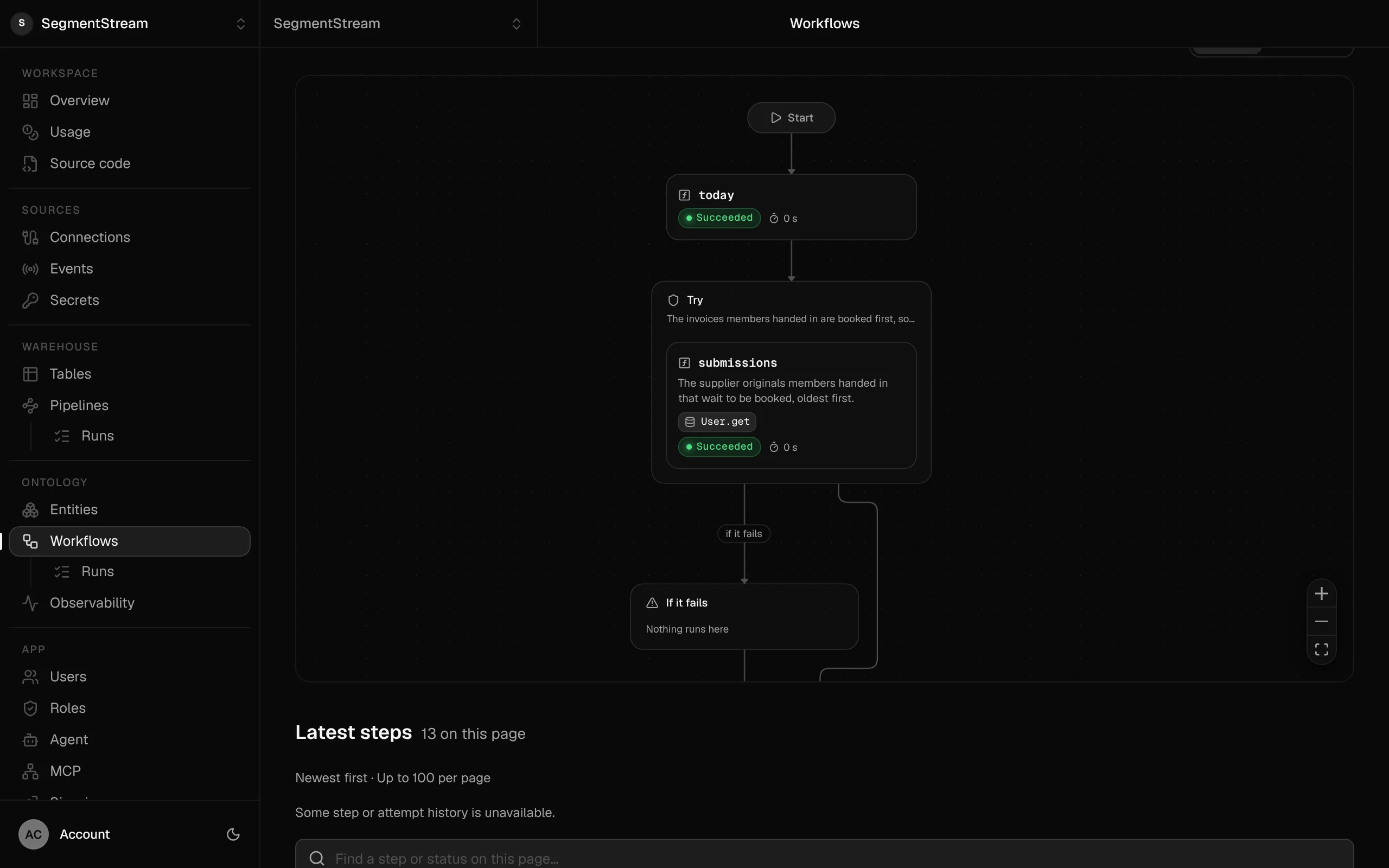
Every run on the map of its workflow.
The map is read from the workflow's code. Each run shows the path it took and every step's status and duration, on the same records as the rest of the company.
SegmentStream and Zapier together
Zapier passes events from the tools you keep into SegmentStream workflows through their webhooks, and SegmentStream keeps the records, the rules and the company agent.
Questions
Is SegmentStream a Zapier alternative?
For processes that change your company’s own records, yes. For connecting SaaS tools you keep, Zapier is built for that, and it can call a SegmentStream workflow.
Can Zapier start a SegmentStream workflow?
Yes, through the workflow’s webhook, with a token so only Zapier can call it.
Do we need developers to write SegmentStream workflows?
No. Your coding agent writes the workflows, or our engineers build them with you.
More comparisons
All comparisons →- SegmentStream vs n8nVisual workflows between tools, or work that runs on your own records
- SegmentStream vs Microsoft Copilot StudioAgents built in Microsoft 365, or a company agent on your own records
- SegmentStream vs RetoolApps over the databases you have, or the system underneath and the apps on it
Last reviewed: October 2026. What this page says about Zapier comes from its own site and documentation:
Build your company’s own software. Let agents run it.
$ segmentstream workspace create acme --region eu --subdomain acme
▸ Created workspace acme · database, warehouse and a private git repository
$ segmentstream workspace WORKSPACE-ID clone acme && cd acme
▸ your coding agent builds what your team asked for and runs the checks
$ git add -A && git commit -m "First version"
$ segmentstream deploy
▸ app, company agent, API and MCP tools live for your invited members
Our engineers build the first version on your data in two weeks, at a fixed price.
Or build it yourself with your coding agent:
curl -fsSL https://segmentstream.com/install.sh | sh